
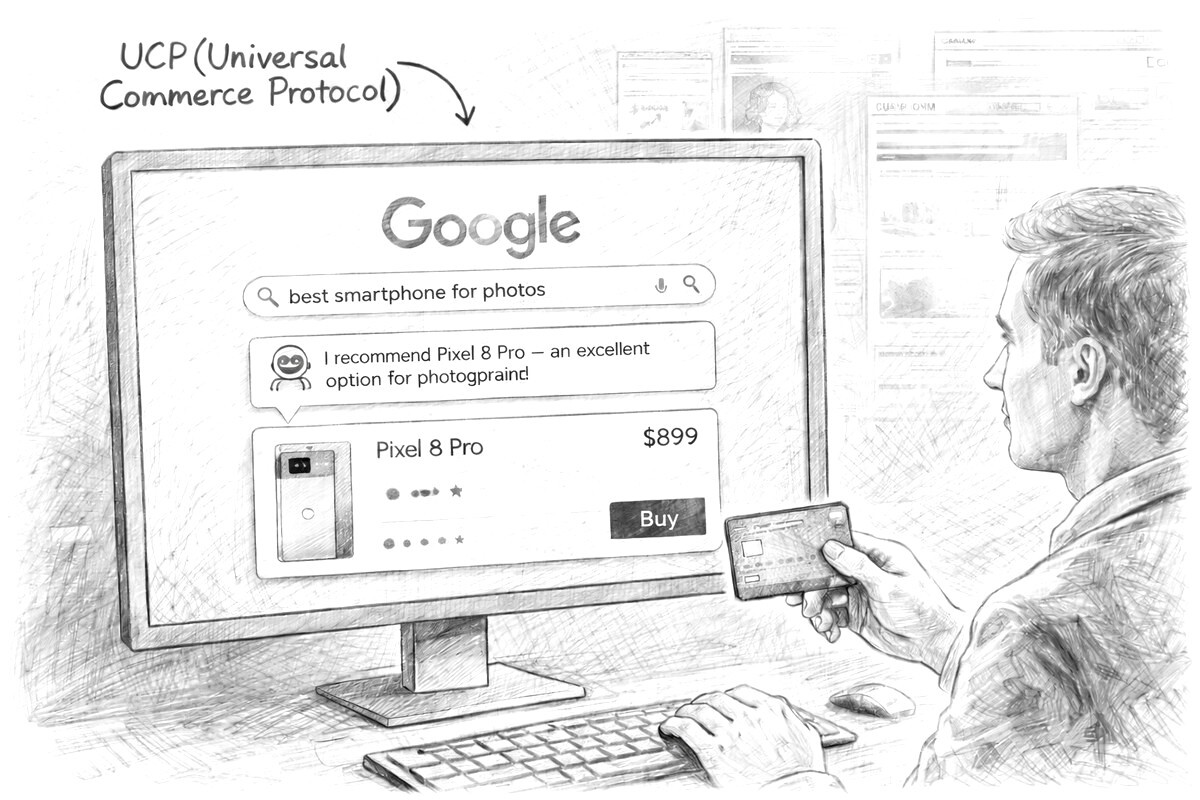
Google is testing a new shopping format: UCP (Universal Commerce Protocol). Put very simply, it’s a purchasing scenario where about 90% of the journey happens directly inside the search interface. Here’s how it works:
- the user asks the AI,
- gets a recommendation,
- and completes the purchase right away, without opening dozens of websites.
In essence, it’s the same pattern we described in the Perplexity “conversion into a lead” case – only this time it’s e-commerce, and in the long run it may happen without visiting the store’s site at all.
What’s changed compared to traditional e-commerce
Previously, the path looked like this:
Search → list of websites → user-driven comparison → clicks → cart → purchase.
Now Google wants to shorten the chain:
Search → AI filtering and recommendation → purchase.
A user might type a prompt like: “Black skinny jeans, size 40, up to €50, delivered in Valencia.” The AI will then select options and help complete the order directly within Google’s ecosystem.
Important: the purchase still happens with the merchant – Google does not become the seller. But it does become a digital advisor that leads the customer to a purchase. And from an SEO standpoint, the key question appears immediately: which store does it lead the customer to – yours or your competitor’s?
What this looks like from the website’s side
In practical terms, this will be an integration via Google Merchant Center. What will be required:
- A verified website and domain.
- A clean product feed with specific, correctly filled attributes: ID, title, description, link, image_link, price, etc. No errors. Errors can result in exclusion from the selection.
- Product attributes need to be written for the AI, not for a human marketer – no ads, no fluff, no clickbait.
- Structured data and markup, including ShippingDetails and ReturnPolicy. Shipping and returns matter because they also influence selection. If a competitor’s delivery and return terms are better, the AI will recommend them instead of you.
- The AI cross-checks the feed against the on-site markup, so there must be no discrepancies. Feed updates should be automated.
- A simple, clear, logical purchase flow – no unnecessary pop-ups, confirmations, or hidden steps.
- Reviews. Naturally, you can’t do without them.
Some of this has always been part of SEO work, but requirements are becoming stricter and more complex. The workload increases – so it’s reasonable to expect SEO services to become more expensive as these changes roll out.
Is Google the only one moving toward AI-based purchasing?
No. ChatGPT already has built-in shopping tools (Shopping Research). They’re not perfect yet, but the direction is clear: OpenAI is moving toward zero-click commerce, where decision and action happen without the traditional “tour” across multiple websites. There’s little doubt other AI systems will follow.
In practice, the AI becomes a new entry point into the purchase journey.
What this means for online stores
1) A new sales channel appears. Users arrive with purchase intent. Not to “browse,” but to choose and complete an order. That means conversion rates can increase significantly – which, against the backdrop of overall traffic decline, may be some consolation. But not for everyone: only for those who prepare well.
2) You lose some control. Design, storytelling, cross-selling – part of these tools fall outside the scenario if the purchase starts through AI. From the merchant side, influence over the user’s decision drops close to zero. These will be hot leads. The key task becomes providing a smooth, clear, simple, frictionless checkout experience. That “frictionless” quality will be a decisive factor.
3) Your data must be perfect. If prices are outdated, stock levels are wrong, or attributes are incomplete, the AI may send you a customer who hits a broken expectation and leaves. Next time, the system may simply not choose your store. Or it may not choose it from the start – that will depend on the algorithm. We’ll see.
What you have to do right now
- Check your catalog: names, variants, attributes, photos, prices.
- Make sure stock and delivery information is always up to date.
- Track how AI mentions and recommends your brand (for example using our ELNIQ GEO platform).
- As soon as there’s an opportunity to jump on the train – jump.
UCP is not just a new feature. It’s a signal that purchasing is gradually moving into AI interfaces. And the main question for online stores now becomes:
Is your store ready to be chosen by an algorithm?
If your answer is “no,” “I don’t know,” or “I’ll think about it tomorrow,” your competitors will be glad. Think about it today and make the right decision.